
Key takeaways
N2Growth’s 2026 research on the future of HR combines a panel of 40 leading CHROs with an analysis of 1,000+ CHRO careers.
In five years, the CHRO will be held accountable for AI outcomes more than any other C-suite leader. 60% of N2Growth’s panel of 40 leading Chief Human Resources Officers (CHROs) expect the CHRO to answer for AI outcomes more than any C-suite peer, and 68% expect containing AI costs to become a significant added responsibility.
Almost none of our panel of CHROs expect AI to grow headcount. 39 of the 40 panelists expect large companies to cut headcount, hold it flat, or cycle between both over the next five years. 18 of the 40 name entry-level workers as the group AI will hit hardest, and none name senior leaders and executives.
CHROs face more risk from moving too slowly on AI than too quickly. 95% of the panel expect CHROs to more often lose their jobs for moving too slowly on AI than too quickly.
AI is arriving in HR more slowly than CHROs expected. 24 of 35 panelists last year expected AI to automate half or more of HR service delivery steps by now, but only 11 of this year’s 40 panelists report having already achieved that.
Boards keep hiring the same CHRO profile, even though the role is changing. Only 7 of 462 sitting S&P 500 CHROs held a technology role in any of their last three positions. The share of repeat CHROs has not moved significantly since 2019, and arrivals from outside HR have not moved since 2023.
Company size predicts CHRO turnover better than hire type. A CHRO at a large company is 67% more likely to leave in a given year than one at a small company. Whether a CHRO was hired externally, came from outside HR, or is in the seat for the first time makes no statistically significant difference.
Who this research is for
This report’s insights are intended to help:
Boards and CEOs defining what the CHRO role must cover as AI is integrated into workflows, and what that means for the CHRO they have and the one they hire next.
Sitting CHROs deciding how fast to move on AI, redesigning work across the business, and shaping what the role becomes.
Aspiring CHROs building the skills and experience they need to grow into the role as it evolves.
The Chief Human Resources Officer and the future of work
What is the future of the CHRO and the work they lead?
What should boards and CEOs be looking for in their next CHRO? How should current and aspiring CHROs prepare themselves and their workforces for the future of work?
The future of HR leadership and of work itself is unknown. We’re at a moment of transformation where the basic questions about work are more uncertain than they have been in decades. Who will do the work? Humans or AI agents? Who will be responsible for overseeing technology? Technology leaders, people leaders, or someone else? Will much of human work become managing AI agents? Will AI supervise and direct human workers? Amidst such uncertainty, how do boards and CEOs select CHROs who can lead their workforces into the future? What skills, abilities, and values do current and aspiring CHROs need to develop through their experiences to lead the people function into the future?
Anticipating the future of the CHRO and work
There’s no sure way to know the future. But there is a gold-standard method for future-casting. Decision makers in many fields, including medicine and policymaking, turn to the Delphi method to plan and prepare for possible futures, especially when operating in environments where information is incomplete and uncertainty high. The method uses the anonymous judgments of leading experts in a field to find where they agree and where they split and, based on those lines of agreement and disagreement, gives decision makers insight into the likelihood of various possible scenarios.1
Our study adapts the Delphi method to future-cast the next five years of the people function and its leadership. In a single round, we surveyed a panel of 40 leading CHROs, asking them to choose the future they expect from a set of options, a forced-choice design intended to reveal “leading,” “expected,” and “alternative” scenarios and “open questions,” with “signals” drawn from comparison with last year’s panel.2 The premise of the study is that a panel of CHROs at the leading edge of the function is more likely to see and shape the future of the human resources function and the workforce they lead. Together, their expectations show where leading CHROs agree and where they split, and thereby prove valuable for sensing likely futures for the CHRO position and work. The aim of the study, therefore, is not to offer a prediction of the future, but to outline the aggregate vision of leading CHROs as a means for sensing and then planning for the future of the CHRO and the work they lead.
To gain a fuller picture of the CHRO role, including hiring trends, our study pairs our Delphi-style panel with an extensive quantitative analysis of CHRO appointments, profiles, and career trajectories, tracing appointments back to 2019. When combined, the macro quantitative analysis and the Delphi-style qualitative panel reveal how current CHRO experience baselines, their profiles when hired, intersect with the future scope of the role and the type of work and workforce CHROs will lead.
Overall, we found that the mandate CHROs will be expected to own is expanding faster than the pipeline into it. As a consequence, boards and CEOs may have to think expansively and creatively to find the CHRO they need, while also intentionally creating broad development plans to prepare internal successors. Current and aspiring CHROs, for their part, should plan to grow their skill sets to include business and technology leadership.
A panel of 40 leading CHROs from the world’s top companies
N2Growth’s 2026 panel included 40 leading Chief Human Resources Officers from S&P 500 and Fortune Global 500 companies, private firms, global professional partnerships, and not-for-profits. Together, they lead more than 4.6 million people at organizations generating more than $2.3 trillion in revenue.
The quantitative analysis: 1,000+ CHRO careers across 34 countries and territories
N2Growth’s quantitative analysis, the N2Growth CHRO census, covers more than 1,000 CHROs, including the 906 in the seat in July 2026, at companies headquartered in 34 countries and territories, drawn from the S&P 500, the Fortune Global 500, Forbes America’s Most Successful Mid-Cap Companies, Forbes America’s Top Private Companies, and LinkedIn Top Companies (together, the N2Growth composite index). It follows every S&P 500 CHRO seat across four snapshots from December 2023 to July 2026, with appointments traced back to 2019. More than 100,000 data points span titles and second functions, hiring routes, tenure, the last three roles before the seat, and gender, alongside each company’s sector, ownership, size, and region.
Key findings on the future of HR from 2026 CHRO research
Expectations for CHROs are widening. Organizations will increasingly lean on the CHRO for help integrating AI into the organization’s work. CHROs will need to be able to offer a strategic perspective on whether and how work should be redesigned, where human-AI risks land, and how AI costs should be controlled. The traditional pipeline feeding the role has not yet caught up, but current CHROs and aspiring ones have the opportunity now to grow their skill sets, lead on AI, and move the organization forward.
A preview of the future
A snapshot of what our panel of 40 leading CHROs expects over the next five years
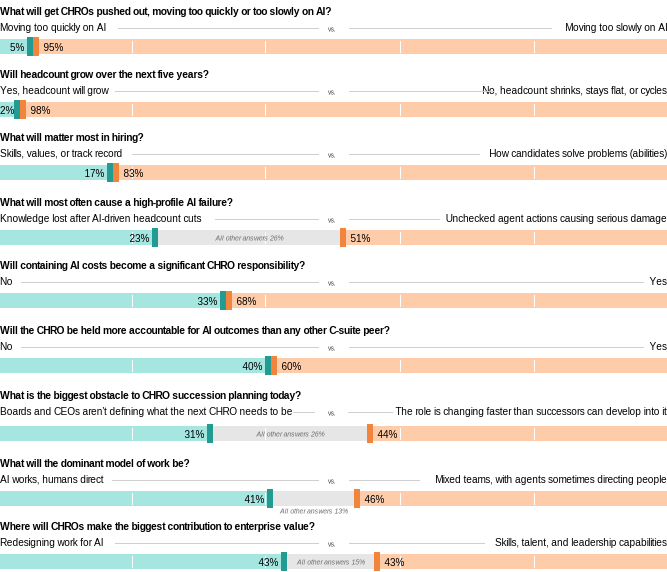
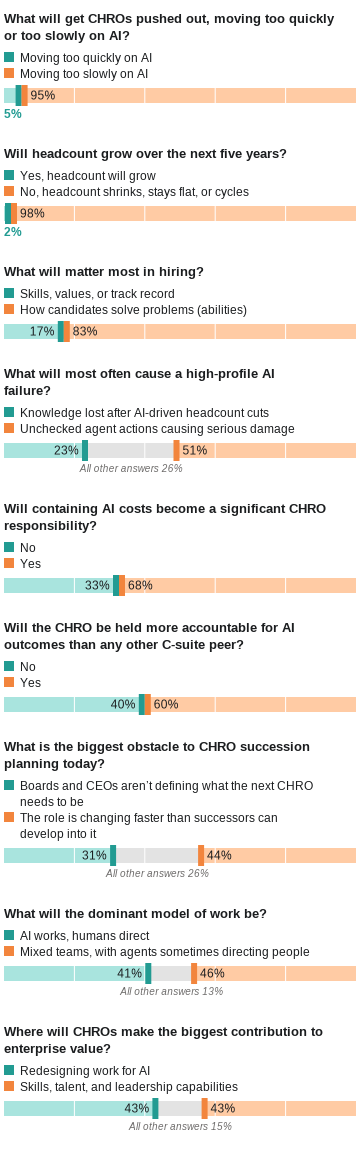
The questions and answers have been condensed for the preview. Each question’s full wording and answer options are given where it is discussed in the full white paper.
Seven in ten first-time CHROs held only HR roles before their appointments
27.0% of CHROs held generalist HR roles throughout their last three roles, 44.0% took a specialist detour, and 29.0% came by a business route.
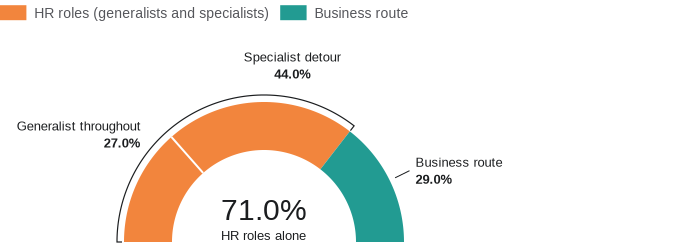
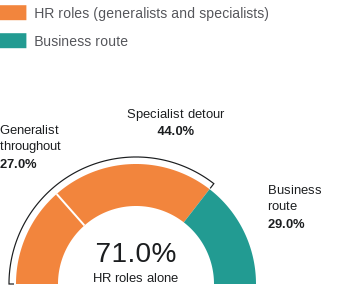
Generalist roles cover HR as a whole for a business or region, such as HR business partner. Specialist roles focus on one area, such as talent or rewards.
CHROs who came from outside HR are usually internal hires
Of the 71 S&P 500 CHROs who came from outside HR, 52 (73.2%) were first-timers promoted from within.
Chart would be displayed here
Source: N2Growth CHRO census, S&P 500, July 2026; 456 with previous function known.
The S&P 500’s smallest companies hire CHROs from outside more often than its largest
Chart would be displayed here
Europe and Asia-Pacific draw more of their CHROs from outside HR than U.S. and Canada
Chart would be displayed here
About one in seven CHRO seats changes hands each year
Between 13.3% and 15.9% of CHRO seats changed hands each year between 2024 and 2026.
Chart would be displayed here
2026 is annualized from January to July. The differences between years are not statistically significant.
Company size predicts CHRO turnover more than hire type
CHROs at the largest companies in the S&P 500 are about two-thirds more likely to leave in a given year than those at the smallest quarter.
Chart would be displayed here
Source: N2Growth CHRO census, S&P 500, December 2023 to July 2026; model described in the Methodology. Lines show the range the data allow. Only company size is significant. The other three ranges include no change, and the model also accounts for gender.
Two in five CHROs have been in the seat less than three years
Sitting S&P 500 CHROs have served a median of 3.6 years; 42.0% have been in the seat less than three.
Chart would be displayed here
Source: N2Growth CHRO census, S&P 500, July 2026; 448 with a known tenure. Time in the seat so far, not completed terms.
One in six CHROs carries a second function
Chart would be displayed here
Source: N2Growth CHRO census, S&P 500, July 2026. Some titles name more than one function, so the functions add up to more than 73.
How to prepare for the future of work: action items for boards and CEOs, current CHROs, and aspiring CHROs
For boards and CEOs
1. You are likely to hold your CHRO accountable for something you have never evaluated before. Twenty-four of our 40 panelists expect the CHRO to answer for AI outcomes more than any other C-suite peer, but hiring has not yet caught up. Only seven of 462 sitting S&P 500 CHROs held a technology role in their last three roles, and the profile of new appointments has not changed significantly since 2019.
At your next appointment, decide whether AI accountability sits with the CHRO, and rewrite the specification to match. The market will not supply that experience by default, since more than four in five CHROs arrive straight from an HR role without technology experience.
2. You will likely appoint a new CHRO in the next five years. About one in seven S&P 500 CHRO seats changes hands each year, and nearly two in three sitting CHROs (62.5%) took the seat in the past five years. Turnover is fastest at the largest companies, which also fill the seat from inside most often, promoting two in three of their CHROs from within.
If your company is in the largest quarter of the S&P 500 by revenue, prepare your next CHRO for AI through development, naming at least two internal successors and readying them for the role as it will be in five years, while also identifying an emergency successor and an external successor. If it is in the smallest quarter, where half of CHROs are hired from outside and succession plans are less durable, prepare for the search by writing the AI and technology requirements into the specification, while also naming at least two internal successors, an emergency successor, and an external successor.
3. Your organization is likely to face AI failures from workforce risks that the board rarely reviews, just as CHROs are spending less time with boards and CEOs than they did last year. Of the 39 panelists who answered, 20 named unchecked agent actions and nine named knowledge lost after AI-driven cuts as the most common cause of a high-profile AI failure, and cyber reporting rarely covers either. At the same time, 36% of this year’s panel spend six or more hours a week on CEO and board advisory, against 48% of last year’s.
Have your CHRO report regularly on both risks, starting with where AI agents act without human review. Approve no AI-driven workforce reduction without the CHRO’s plan to retain knowledge and keep the entry-level pipeline full. Enhance your operating rhythms and board agendas to include more standing time with your CHRO.
For current CHROs
1. HR’s work is taking longer to automate than leading CHROs predicted. Last year, 24 of the 35 CHROs on our 2025 panel expected half or more of HR service delivery to be AI-automated within 12 months. This year, 11 of our 40 report it, and 28 again expect it within a year.
Name specific HR processes to automate, set a 12-month automation target you can hit, and upwardly publish the results. Promising more than HR delivers on its own automation is one way “too slow on AI” gets pinned on a CHRO, and 38 of our 40 panelists see moving too slowly as a significant career risk for CHROs.
2. Choosing your HR leadership team may be your most consequential AI decision. As AI takes more of your week, your team will have more responsibility for running HR. Twice as many of this year’s panelists spend six or more hours a week on AI as last year’s did (49%, against 24%), and fewer spend that much time leading HR (43%, against 71%).
Choose an HR leadership team that can run HR day to day, and give them real decision rights now, so your time can go to the AI questions where the board and CEO most need your judgment. Agree on which decisions are theirs, and institute an operating rhythm to revisit the split as your AI role grows.
3. Many of your peers expect culture to set companies apart, yet almost none see it as where the CHRO adds the most value. With the same AI tools available to every company, 19 of our 40 panelists expect culture to set companies apart, but only two named culture as the CHRO’s biggest contribution to enterprise value.
Claim culture as your agenda, including the culture AI agents create when they direct people in mixed teams, which 18 of 39 panelists expect. No other member of the C-suite is as well placed to own it.
For aspiring CHROs
1. CHROs still mostly come through careers in HR, but need business experience to succeed in the role. Of first-time S&P 500 CHROs, four in five held an HR role right before their appointment, most often a generalist HR leadership role (about half). Once in the seat, the work turns commercial, and 15 of our 40 panelists already spend six or more hours a week on business and P&L leadership.
Build business breadth inside HR, through business-unit HR roles with P&L exposure and work on major deals.
2. Technology and AI experience will set you apart. Only seven of 462 sitting S&P 500 CHROs held a technology role in their last three roles, and 16 of our 40 panelists name technology and AI as the most consequential gap in first-time candidates.
Lead the AI redesign of major HR initiatives and own their results. Few candidates for the seat will be able to show the same.
3. Your first CHRO seat will most likely come from inside your own company. Four in five first-time S&P 500 CHROs were promoted from within, and seven in ten external hires had held the seat before.
Treat your company’s succession process as more important to you than the search market, and work to become a named successor.
Methodology
To explore where the Chief Human Resources Officer stands today and where the role and work itself are headed, we created a Delphi-style panel of 40 leading CHROs and paired their findings with a statistical profile we built of more than 1,000 CHROs across 34 countries and territories.
Our panel of leading CHROs
The panel consisted of 40 leading CHROs. We fielded our questions in September and October 2026, using a Delphi-style method with one anonymous round of 15 forced-choice questions. We report the answers as counts and splits, read against how strongly the panel agrees, and do not test them statistically. An expected scenario is one that at least seven in ten panelists share. A leading scenario is the most common answer without that level of agreement, and the alternative scenario is the main competing view. An open question marks a split with no clear leading view. Unless otherwise noted, panel charts report the answers of all 40 members of N2Growth’s 2026 CHRO panel.
Some charts compare this year’s panel with the 35 leading CHROs we surveyed last year. Because the two panels are not the same people, we treat differences between them as signals rather than trends.
The quantitative analysis
The quantitative analysis (the census) records one CHRO per S&P 500 company, the executive who leads HR for the whole company. Interim and acting heads are not counted. The census follows the S&P 500, held at its 2026 membership, at four snapshots from December 2023 to July 2026, covering the 168 departures between them. The source data is drawn from company filings, websites, announcements, and a proprietary third-party database.
Bases vary slightly from chart to chart, since each figure counts only the CHROs for whom that trait or answer is known, and percentages are rounded. Tenure is time in the seat so far. Appointments before December 2023 are seen only through CHROs still in the seat, which is why some figures start in 2023. Career analysis classifies the three roles each CHRO held before the seat by function and, for HR roles, by specialty.
Beyond the S&P 500, we looked at the 444 CHROs in the seat in July 2026 at companies on four other lists: the Fortune Global 500, Forbes America’s Most Successful Mid-Cap Companies, Forbes America’s Top Private Companies, and LinkedIn Top Companies. Together with the S&P 500, these lists make up the N2Growth composite index, which counts each of its 906 companies with a CHRO once; those companies are headquartered in 34 countries and territories. The census’s more than 1,000 CHROs are the 906 in the seat in July 2026 plus the S&P 500 CHROs who left after December 2023. Regions follow the Fortune Global 500’s headquarters country, except that every S&P 500 company counts as U.S. and Canada. Asia-Pacific (APAC) covers Australia, China, Hong Kong, India, Indonesia, Japan, Malaysia, Singapore, South Korea, and Taiwan. Latin America and the Middle East have too few CHROs to report. Where the paper sets the lists side by side, each list is counted on its own. Except where other titles are named, we use CIO (Chief Information Officer) as shorthand for a company’s most senior technology leader, whatever the title.
Statistical tests
We test census comparisons with chi-square tests (with a continuity correction where two shares are compared), Mann–Whitney tests for medians, and McNemar tests where the same CHROs are compared across career steps. Most logistic regressions for hiring and careers take sector and the log of 2025 revenue into account. The model of how soon a CHRO leaves is a Cox survival model of 546 tenures, including 142 of the 168 departures (those with the data the model needs). It is left-truncated at the December 2023 snapshot, dates exits midway between snapshots, and takes sector and gender into account. Across the full set of tests, including those for findings we chose not to report, we control the false-discovery rate at 5% with the Benjamini–Hochberg method. Every census difference in the main text passes in a main family of 71 tests, and the sidebar differences pass in a family of 91 that adds the 20 sidebar tests. A stricter family of 88 tests, which adds every other term from our regression models to the main 71, also keeps every main-text difference. Differences that do not pass these tests are not reported as findings. Where lists or regions sit side by side, differences are descriptive unless the text or figure reports a test. Detailed tables and model results are available from N2Growth on request.
Interviews
We interviewed more than 100 CHROs on background, and the full paper features four of them, from Medtronic, United Airlines, PPG, and Ulta Beauty. Their excerpts are edited for length and clarity. Selected full interviews are available at N2Growth’s Executive leadership research and insights page.
FAQs
A board should look for a CHRO who fits the role as it will be in five years, not the role being vacated. In N2Growth’s 2026 panel of 40 leading CHROs, 44% name the role changing faster than successors can develop as the biggest obstacle to succession, and 16 of 40 name technology and AI as the most consequential gap in first-time candidates, ahead of board and C-suite work at 10. The same questions apply to the CHRO already in the seat, who can be developed toward the role rather than replaced.
The Chief Human Resources Officer role is widening faster than the routes into it, driven largely by AI. CHROs now spend more time on AI and less time leading HR than a year ago, with half of the 2026 panel of 40 leading CHROs giving AI six or more hours a week against a quarter last year. Most of the panel expects the CHRO to answer for AI outcomes more than any C-suite peer and to pick up containing AI costs as a significant added responsibility.
Accountability for AI is shifting toward the CHRO, and N2Growth’s 2026 panel of 40 leading CHROs expect the line to keep moving. 60% expect the CHRO to answer for AI outcomes more than any C-suite peer, including the CIO, and 68% expect containing AI costs to become a significant added responsibility. Titles have not caught up, with only 6 of 462 S&P 500 CHROs carrying technology, digital, or AI in the title.
AI will rebuild roles, not just automate tasks, according to the 2026 panel of leading CHROs. 34 of the 39 panelists who answered expect rebuilt roles within five years. They split only on who ends up in charge. 18 expect mixed teams in which agents sometimes supervise people doing the work, while 16 expect people directing agents to do the work.
Companies hire CHROs both internally and externally, about three in five from within and two in five from outside across the S&P 500, and each offers something different. 71% of the S&P 500 CHROs hired from outside had already held the seat, while internal promotions are usually first-time CHROs. Smaller companies go outside more often, 50% at the smallest quarter by revenue against 34% at the largest.
Sitting S&P 500 CHROs have served a median of 3.6 years, and 42% have been in the seat for under three years. About one in seven seats changes hands each year, 13% in 2024 and 15% in 2025. Company size can predict how soon a CHRO leaves, with large-company CHROs 67% more likely to leave in a given year.
Most Chief Human Resources Officers still reach the role through HR, but the experience boards will need is changing faster than the route into it has. Seven in ten first-time S&P 500 CHROs spent all three prior roles in HR, while one in five came to the role from outside HR. Sixteen of 40 leading CHROs on the 2026 panel name technology and AI as the most consequential gap in first-time candidates, ahead of board and C-suite work at 10. Aspiring CHROs should build the ability to lead an AI-enabled workforce, and the business experience to be credible beyond HR.
AI is unlikely to replace HR, but it will reshape the workforce HR leads. In N2Growth’s 2026 panel of 40 leading CHROs, only 1 expects AI to grow headcount at large companies within five years, and 25 expect cuts, either lasting or as part of a cycle. 18 of the 40 name entry-level workers as the group AI will hit hardest, and none name senior leaders and executives. That puts HR in charge of deciding which roles change, what knowledge the company keeps, and how to rebuild the entry-level pipeline.
In five years, AI will automate half or more of the process steps in most HR domains, according to the 2026 panel of 40 leading CHROs. In six of seven core HR domains, from talent acquisition to people analytics, 33 to 38 of the 40 expect AI to automate half or more of the process steps within five years. Employee and labor relations is the exception, at 14 of 40. Most of the panel also expects work to be rebuilt around AI, so HR’s near-term task is to redesign its own roles and reskill its people before the automation arrives.
Connect with the authors behind the research

Tony Morales
Chairman
Lead Author
Miami, FL and Chicago, IL
Trisha Conley
Former CHRO, LyondellBasell
Houston, TX

Sandra Birnie
Director
Vancouver, BC

Steve Manning
Managing Partner, Singapore
Singapore
1 Dmitry Khodyakov, Sean Grant, Jack Kroger, and Melissa Bauman, “RAND Methodological Guidance for Conducting and Critically Appraising Delphi Panels,” RAND, December 29, 2023.
2 Tony Morales et al., “The leading-edge CHRO: The future of the people function is here,” N2Growth, December 2025.
The Future of the CHRO: Trends for 2027 and What Comes Next
Placing and advising the leaders of tomorrow
As an executive search firm, companies call upon us to find world-class talent and we deliver. But, it’s our fully integrated portfolio of leadership advisory services that sets us apart.
Contact us to learn how we can help you attract, develop, and unleash leaders.
Let's get in touch
Send us a message and a consultant will reach out shortly.
 English (United States)
 English (Canada)
 English (UK)
 Spanish (Spain)
 Spanish (Mexico)
 Spanish (Chile)
 French
 Portuguese (Brazil)
 Portuguese (Portugal)
 Dutch