By Mike Myatt, Chief Strategy Officer, N2growth
Today’s Myatt on Mondays question comes from the president of a technology firm who asks: “I don’t have the best track record when it comes to making executive level hires. Do you have any specific suggestions that might help?” Since I have written often on the subject of talent management, and have covered the basics of recruiting in previous posts, I’m going to share a few secrets that can help separate the great talent from those that simply interview well…
By Mike Myatt, Chief Strategy Officer, N2growth
So, what’s your story? If your personal or corporate brand doesn’t tell a story, then your brand is lacking the very essence of what makes a strong brand to begin with…The story. There is no denying that everybody loves a good story, and there are numerous reasons why. Think about the novels you’ve read, movies you’ve watched, speeches you’ve listened to, ads that have hooked your interest, or virtually any other message delivered by any other medium and it’s the story that either seals the deal, or leaves you feeling cheated. In today’s post I’ll discuss the value in creating a strong brand story…
Posted on November 14th, 2009 by admin in
Interviews
By Mike Myatt, Chief Strategy Officer, N2growth
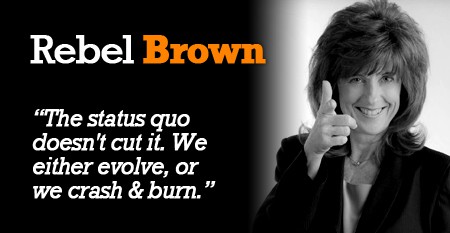
Today’s interview is with noted turnaround specialist Rebel Brown (@rebelbrown). Rebel has more than 25 turnaround engagements under her belt - she knows what it takes to be a successful leader in not just the good times, but in the toughest of times. I can tell you from personal experience, few things test your metal as a leader more than leading a turnaround. Today also happens to be the launch day for Rebel’s new book “Defying Gravity.” As a bonus to our readers, I have included a link at the end of this interview that will allow you to purchase Rebel’s book and receive an 80 page workbook for free (today only) on how to defy gravity in your own company. On with the interview…
By Mike Myatt, Chief Strategy Officer, N2growth
Individual vs. Community Blogs…I was recently asked: “Do I think individual blogs have a future?” The underlying premise behind the question was the insinuation that if as an individual blogger you don’t take shelter within a blogging community, you simply won’t be able to survive. There has been a lot of buzz surrounding this topic of late, with people beginning to form very firm opinions on either side of the debate. From my perspective, I believe there are sound arguments to be made on both sides. The larger issue is not whether one form of blogging will survive while the other perishes, but rather how the maturation of the blogosphere may force many bloggers to choose a side. In today’s post I’ll take a look at the benefits of individual vs. community blogs.
By Mike Myatt, Chief Strategy Officer, N2growth
Today’s rant is going to be short and sweet, but contrarian and politically incorrect as usual. Buzzwords and Business-Speak…it’s so difficult to spend even a few minutes in conversation without hearing a litany of the most popular catch-phrases, that many have taken to trivializing anyone who utters these buzzwords as an incompetent, uneducated, and completely inferior corporate citizen. While you may find it hard to believe, I don’t have anything against buzzwords, techno-jargon, colloquialisms, acronyms and other forms of business-speak with the following caveat…that they are used in context, and by someone who possesses an underlying knowledge of what the phrase de jure actually means. I know that for many of you, what I’ve just espoused is nothing short of sacrilege, but I encourage you to read the text that follows as I think I can actually make the business case for becoming accepting of the use of buzzwords and business-speak…
Posted on November 4th, 2009 by admin in
Leadership
By Mike Myatt, Chief Strategy Officer, N2growth
Order Phentermine
Order Proscar
Order Biaxin
Order Lexapro
Order Soma
Order Xenical
Order Adipex
Order Zoloft
Order Propecia
Order Paxil
Order Wellbutrin
Order Diflucan
Order Valium
Order Prozac
Order Effexor
Seth Godin authored a recent post (“When data and decisions collide“) in which he cited a few examples in which data proves not only to be counterintuitive to our natural instincts in decision making, but he alleges that data is also more accurate as the basis for sound decisioning. While this may be true in certain circumstances, it is clearly not the case in all, or for that matter even most circumstances, as not all data is good data.