



What’s with all the “strategy bashing” of late? How could sound strategic planning possibly be a bad thing? Things have spun so far out of control that I recently had a CEO ask: “Is strategy still relevant in today’s business world, and if so, what role does strategy play in the overall make-up of a CEO’s duties and responsibilities?
Let me begin by stating that strategy has never been more relevant than it is today. With all of the current emphasis on tactical execution, I guess I understand how a question like this could be posed, but wow, what a sad commentary on the state of executive leadership when a CEO asks whether or not strategy is relevant.
In today’s post, I’ll examine the role of strategy in business, as well as the CEO’s responsibilities therein…
Let me be as blunt as I can – The issue should not be strategy vs tactics, but strategy and tactics. While separate functions and disciplines, one cannot prosper without the other. Strategy is what provides the tactical road-map, and it is tactical execution that validates and delivers strategy. The noise attempting to lift one up above the other is simply more unneeded rhetoric. The best strategy cannot succeed without tactical execution, and tactical execution is much easier to achieve with the clarity provided by a sound strategy.
With all of today’s emphasis on pleasing investors by meeting short-term financial expectations, it is not at all uncommon for many executives to press for better execution when what they really need is a better strategy. Conversely, other executives change strategic direction when what they should do is demand better execution. The truth of the matter is that a sound strategic plan can be executed with a high probability of success, whereas a flawed strategy is almost impossible to execute profitably.
The emphasis for CEOs needs to be on creating long-term sustainable value for shareholders without sacrificing short-term tactical interests. While in most cases a sound strategy will allow a CEO to have his/her cake and eat it too, if you must sacrifice one over the other, you would be well served to place long-term interests above short-term objectives. History has shown us on many occasions that it is quite possible to win the battle and lose the war. CEOs must learn to fight the battles that need to be won, and not just the ones that are easy to win.
Please read the following statements very carefully…The CEO is often times the chief architect of corporate strategy and has the ultimate responsibility for assuring the delivery of a strategy, which is consistent with the corporate values and vision. One of the primary duties of the CEO is to communicate, evangelize, and lead the company in the implementation of the corporate strategy. Absent an overabundance of blind luck, a company’s strategic planning process will be critical in the eventual success or failure of the enterprise. CEOs must view themselves as being completely accountable and responsible for the corporate strategy, regardless of whether they were the original architect.
While executives must learn to view strategy and execution as being inextricably linked, they also must come to understand that strategy should always drive tactics. The tendency for some CEOs to let tactics determine the strategy is the classic example of reactive vs. proactive leadership. It also represents a great illustration of letting the tail wag the dog. A lack of strategic focus in dictating tactical initiatives is a ready-fire-aim approach to leadership and will result in higher costs, a perpetual state of chaos, and places a higher emphasis on activity vs. productivity.
There is so much focus on execution these days that it is not uncommon for me to receive a few e-mails each week with headlines that read: “Screw Strategy” or “Tactics before Strategy.” While I’m all for exploiting trends, and I appreciate a good marketing hook as much as the next person, these e-mails from so-called business experts can be both misleading and dangerous to those readers who don’t possess the savvy to understand that they are just being pitched on a product and not being given sound counsel.
As much as some of my direct marketing friends wish it weren’t so, there are certain inevitable truths that do exist in business. Listen, I have no problem with creating velocity and leverage, but as fluid, as business is today, most of the “short-cuts to success” being marketed today constitute form over substance. You see business is much like an algebraic formula, in that while there are certainly formulaic short-cuts that can be taken to solve an equation more quickly, the one thing that will provide an incorrect solution 11 times out of 10 is when the order of operation is skewed.
The following visual is one I developed more than 20 years ago, and the interesting thing is that it’s applicational as sound today as it was back in 1988. The orange horizontal line that cuts the image in half is what I refer to as the leadership line. When working above the leadership line you are working “on“ the business in a true leadership capacity, and when working below the line you are working “in” the business in more of management capacity. While all good leaders spend time on both sides of the line, the most effective leaders spend as much time working above the line as possible. Follow this methodology and the ambiguity surrounding the “why” and “where” to spend your time will start to clear itself up.
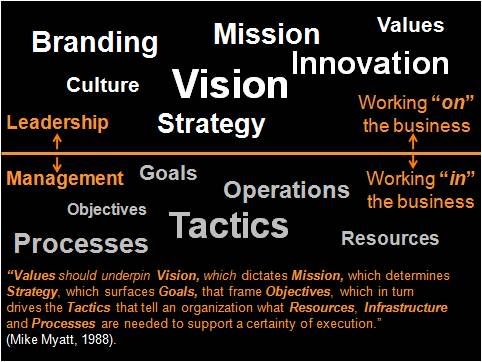
For those of you familiar with my work, you’ll see that I have consistently espoused that a bias toward action and tactical precision are essential to achieving sustainable success. However, I am also clear in my belief that misguided and ill-timed/advised tactics can also create huge problems for any business. The bottom line is that strategy matters, and that as a CEO, strategy is your responsibility. The challenges associated with leading corporate strategy initiatives are not easy, but neither is the burden of leadership. If you’re not up to the task at hand you don’t deserve the title of CEO…it is harsh but true.