



AI and automation are emerging as central catalysts of HR digital transformation. HR Digital transformation refers to the strategic integration of technology, data, and new ways of working to improve how the people function operates. Technologies that play a hand in this transformation are reshaping how work is designed, how talent is developed, and how the people function delivers value. This transformation is already underway, and understanding where AI will have the greatest impact is essential for HR leaders navigating the years ahead.
The rapid acceleration of automation
AI adoption has yet to translate into meaningful implementation across most organizations despite widespread discussion. Through our research, we found that less than 10% of leading CHROs currently have 50% or more process steps automated through AI in five out of seven core HR areas. Only HR service delivery (25.7%) and people analytics (17.1%) surpassed this threshold.
Expectations for AI and automation in HR are high, as 68.6% of leading CHROs expected to have AI automation carrying half the weight or more in HR service delivery within the next 12 months.
Most HR processes will be 50%+ automated within 5 years
“Do you expect that 50% or more of process steps are currently or will be AI-automated in your organization within the timeframes shown?”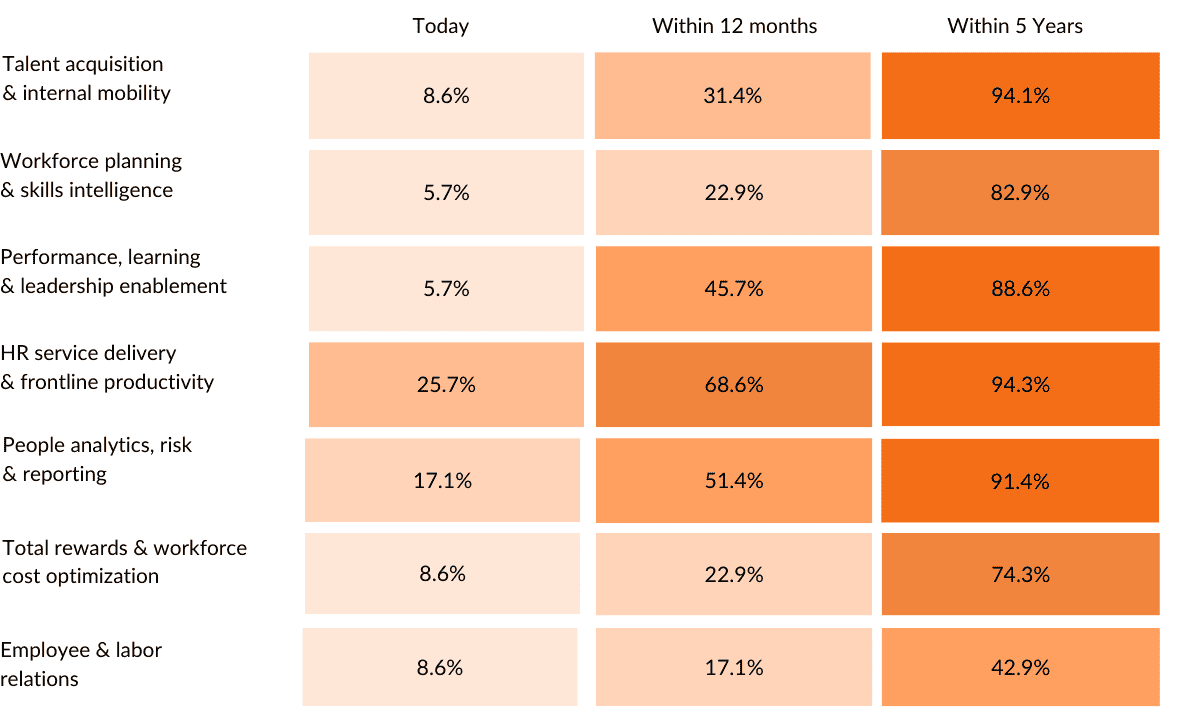
As Diane Johnson May,¹ EVP, Chief People and Culture Officer at The Campbell’s Company shares,
“AI isn’t just top of mind, it’s reshaping the very nature of work.” – Diane Johnson May, EVP, Chief People and Culture Officer, The Campbell’s Company
Echoing May’s sentiment, over 70% of CHROs surveyed expected to see 50% or more of major HR processes automated within the next five years. As we can see here, organizations are moving from cautious experimentation to widespread integration. The impending HR digital transformation will redefine roles, processes, and strategies across the entire people function.
Where AI will actually transform HR
AI and automation in HR is expected to move beyond simple task management. By embedding intelligence into core workflows, AI will empower HR teams to operate with greater speed, precision, and insight. There are seven key use cases across the people function where AI is likely to make the most impact.
1. Talent acquisition & internal mobility
Competition for top talent is intensifying and legacy recruiting processes cannot keep pace. HR automation can offer immediate value by establishing a talent-intelligence layer that could continuously scan internal and external candidate pools, conduct automated screening, and manage scheduling so recruiters can direct their time toward higher-impact interactions.
2. Workforce planning & skills
Strategic workforce planning depends on a precise view of current skills and future capability needs. Artificial intelligence can address this by creating a dynamic, enterprise-wide skills graph that infers capabilities from work outputs and maps them to strategic demand, revealing shortages, surpluses, and redeployment opportunities in real time.
AI becomes a powerful decision tool when applied to scenario modeling. Executives can evaluate alternative portfolio, automation, or location strategies within minutes, quantifying impacts on capacity, reskilling velocity, and cost before making major commitments.
3. Performance, learning & leadership
Performance management and leadership gaps will widen without AI-enabled consistency. HR technology integration can materially strengthen these processes. AI can draft strategy-aligned goals and performance summaries by synthesizing data across systems, enabling managers to concentrate on calibration and delivery rather than administrative tasks enhancing, rather than replacing, the human element of leadership.
4. HR service delivery & frontline productivity
HR service delivery is already shifting under the pressure for speed and scale, and its impact will continue to expand. Intelligent case management, knowledge search, and automated document generation can resolve most employee and manager inquiries, triggering downstream workflows with minimal human involvement and enabling HR teams to redirect their time toward higher-value work.
5. People analytics, risk & reporting
Modern HR increasingly relies on actionable workforce insights, and the next phase of HR digital transformation will significantly expand this capability. AI continuously scans workforce signals to identify emerging risks such as rising attrition or declining engagement and attribute them to underlying drivers like manager practices, workload imbalances, or skills gaps, directing targeted insights to accountable leaders.
6. Total rewards & workforce cost optimization
HR leaders can use automation to bring greater precision to compensation strategy, balancing competitiveness, equity, and cost. Artificial intelligence continuously recalibrates pay structures to reflect market dynamics and internal equity considerations, recommend targeted remediation actions, and propose incentive designs that better align cost with value creation.
AI scenario tools further support disciplined capital allocation by allowing executives to model alternative staffing mixes across roles, locations, and automation levels and immediately assess implications for labor cost, productivity per FTE, and retention of critical talent.
7. Employee & labor relations
Even the nuanced and sensitive area of employee and labor relations benefit from the AI in modernizing HR. AI helps standardize case intake and triage, automatically classifying issues by risk level, applying relevant policy logic, and drafting initial investigation plans and corrective-action letters.
In unionized or works-council environments, AI assistants are powerful tools for bargaining preparation. These systems could synthesize historical agreements, external comparators, and financial scenarios into comprehensive dossiers. By designing these tools with trust, fairness, and compliance as core constraints, organizations can leverage AI to support, rather than undermine, positive labor relations.
Shaping the future of HR in the age of AI
AI transformation will be unlike anything most executives have seen or led before. It is not a simple technology upgrade, but instead a fundamental reinvention of how the people function operates and creates value. Boards and CEOs need leading-edge CHROs to guide the organization through this period of profound uncertainty.
Today’s people leaders must move quickly to guide their organizations through this complex but exciting transition. By understanding the potential use cases and developing a clear strategy for HR technology integration, CHROs can position their function and their entire business for success in an AI-powered future. Download our white paper to learn how leading-edge CHROs are exploring AI solutions to build a more intelligent, agile, and effective HR organization.
¹ “The Campbell’s Company’s Diane Johnson May on the future of the CHRO role,” N2Growth, December 4, 2025.
FAQs on HR digital transformation
HR automation refers to the use of technology, particularly AI, to streamline and optimize HR processes such as talent acquisition, workforce planning, performance management, and employee relations.
AI is transforming HR by automating repetitive tasks, providing data-driven insights, and enabling more strategic decision-making. It will enhance efficiency, improve employee experiences, and support better workforce planning.
AI can be applied across various HR functions, including talent acquisition, workforce planning, performance management, HR service delivery, people analytics, total rewards, and employee relations.
HR digital transformation is crucial for organizations to remain competitive. It enables HR teams to operate more efficiently, make data-driven decisions, and align closely with business goals in a rapidly changing environment.
CHROs are critical in leading AI transformation by envisioning its potential, implementing AI-driven solutions, and guiding their organizations through the changes AI brings to the workforce and HR processes.