

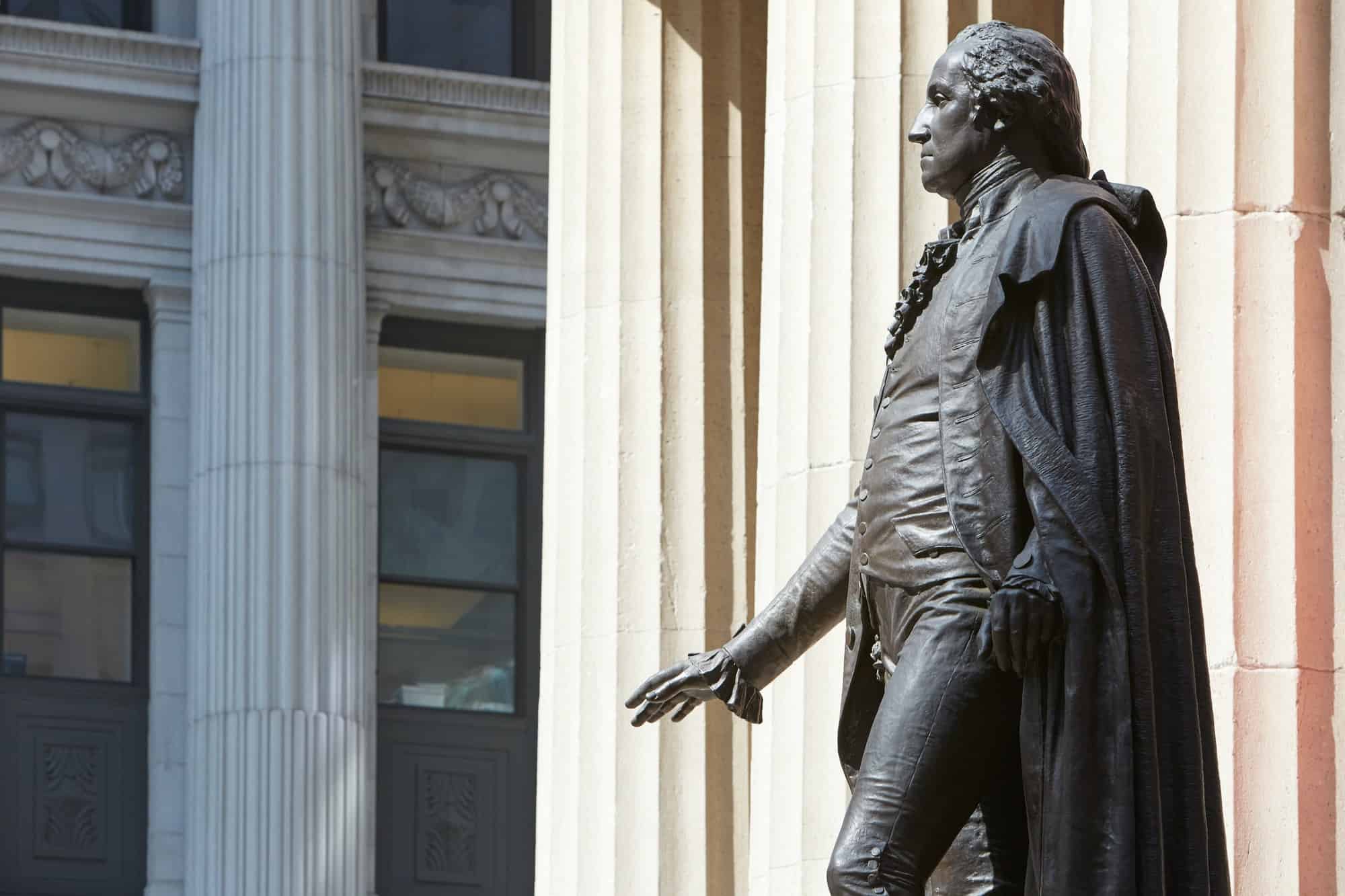

Since we’re headed into President’s Day weekend, I thought I’d re-post a piece that examines the leadership characteristics of the two Presidents for which the holiday is celebrated; George Washington, and Abraham Lincoln. It’s an astute person who studies history and then applies the lessons learned to their present-day life. In the text that follows I’ll look at the unimpeachable character of our first President, and the unparalleled resolve of our sixteenth President.
If I were to take a casual poll asking readers to name our two greatest Presidents it would not shock me at all if Washington and Lincoln would show very well among their peers. However, what I find so interesting in comparing and contrasting these two great men is that while they were both men of staunch character, willing to do the right thing regardless of opposition or public opinion, they were also men who rose to their place in history by traveling very different paths.
Washington was seemingly blessed with success at every turn, while Lincoln failed much more often than he succeeded during his lifetime. Even during Washington’s early years where he was often considered to be brash and impetuous, he was nonetheless considered a bright light and incredibly successful for his age. He consistently sought out positions of leadership & responsibility, and rarely met with any setbacks to speak of.
Born in Westmoreland County, Va., on Feb. 22, 1732, George Washington was a surveyor by trade, joined the Virginia militia just prior to the French and Indian War, served as a delegate to the First and Second Continental Congress, was commander in chief of the Continental Army during the American Revolution, and was the first President of the United States (1789-97). His rise to success was nothing short of meteoric, rising to the rank of Lt. Colonel by the age of 22. His transformation from an ego-centric young man to a polished and savvy leader was nothing short of remarkable.
Even though Washington was both personally and professionally polished, becoming well known for his economic, military, business, and social success, it was his character that he was most admired for. The arrogance of his youth had been transformed into true and unwavering confidence in his own judgment, underpinned with an implacable foundation of principled moral conviction. George Washington was a man of integrity beyond reproach. This made him a man worthy of respect, and a force to be reckoned with. It is important to realize that he did not just espouse a vision, but that he was willing to put his life at risk to defend his vision and live his life with the singular pursuit of seeing his vision become a reality.
Washington’s life gives testimony to the fact that great leaders can accomplish great things. It is important to remember that Washington was not merely a man among midgets who garnered his success because of the ineptness of his contemporaries, rather he was someone who rose to the top of a peer group comprised of John Adams, Thomas Jefferson, Benjamin Franklin, James Madison, and John Hancock among others. Perhaps the greatest testimony to his character was Washington could have been a king but chose not to. His interest was not in acquiring power, but to serve the best interests of a new nation.
By contrast, for the majority of Lincoln’s life, he was largely regarded as a person of little consequence, if he was regarded at all. While he sought positions of leadership and responsibility, he was met with continuous challenges and defeats. Interestingly enough, many of Lincoln’s perceived successes ended in failure.
Simply put, Abraham Lincoln is one of the most inspirational case studies in examining the leadership traits of persistence, commitment, determination, passion, conviction, and overcoming failure. There is perhaps no greater lesson the world can offer in overcoming failures and understanding the value of persistence than what can be learned from looking at the life of Abraham Lincoln. Born into poverty, Mr. Lincoln was faced with defeat throughout most of his life. He twice failed in business, lost eight different elections, and suffered a nervous breakdown. The following bullet points summarize Lincoln’s path to the White House:
- 1816: Lincoln’s family lost their home and he had to quit school to support them.
- 1818: His mother passed away.
- 1831: He failed in business.
- 1832: He ran for the state legislature and lost, also lost his job, and while he wanted to go to law school he couldn’t get in.
- 1833: He borrowed money to start a new business and was bankrupt by the end of the year. He spent the next 17 years paying off the debt.
- 1834: He ran for state legislature again and this time he won.
- 1835: He was engaged to be married and his fiancé died.
- 1836: Mr. Lincoln suffered a total nervous breakdown and spent six months in bed recovering.
- 1838: He sought to become a speaker of the state legislature and was again defeated.
- 1840: He sought to become an elector and was defeated.
- 1843: Lincoln ran for Congress and lost.
- 1846: He ran for Congress again and this time he won.
- 1848: Lincoln lost his re-election race for Congress.
- 1849: He sought the position of land officer in his home state and was turned down.
- 1854: Lincoln ran for the US Senate and lost.
- 1856: He sought the Vice-Presidential nomination and lost receiving less than 100 votes.
- 1858: He ran yet again for the US Senate and lost.
- 1860: Abraham Lincoln was elected as the sixteenth President of the United States.
It was in fact Abraham Lincoln who later said: “My great concern is not whether you have failed, but whether you are content with your failure.” Lincoln was obviously someone who was more focused on pursuing his goals than being guided by a fear of public opinion or of failure. Thomas Edison failed more than 1000 times before he successfully invented the light bulb and he was later quoted as saying: “Many of life’s failures are men who did not realize how close they were to success when they gave up.”
The bottom line is that great leaders are not easily deterred. While most professionals don’t naturally associate the words “success” and “failure” as having anything to do with one another, under the right circumstances failure is absolutely the best experiential learning tool available. In fact, I would go so far as to say failure is an essential element of becoming successful. You can easily validate this premise by placing any individual under the scrutiny of the following litmus test…if you show me a professional who has never experienced failure I’ll say that person is likely an underachiever who either hasn’t tried hard enough or is very new to the world of business. Great leaders don’t fear failure, rather they fear the loss of what could have been achieved had they not had the courage to press on.
The lessons here are simple…be a person of action, stay passionately convicted to your vision, make sure that your motivations and decisions are based upon a deeply rooted sense of character and integrity in both your personal and professional conduct, and be willing to take great risks in order to ensure that your vision becomes a reality. While this brief post cannot even come close to doing justice to the incredible lives of George Washington and Abraham Lincoln, I do hope it provides some inspiration and some guidance as you move forward on your own leadership journey.
Thoughts?