
CIO Hiring Trends 2026: Analyzing the S&P 500 CIO
A constant amidst the storm
Key takeaways
The CIO hiring picture has stayed remarkably stable since 2023. Across the S&P 500, external hiring has held at 60%, the first-time vs. repeat split has stayed the same, and the preference for candidates with company-wide responsibility remains strong. The overall pattern is one of continuity. There is some movement at the edges, however.
Business credentials are falling while technical credentials hold steady. MBA share among new CIOs fell from 38% to 29% since 2023, while CS-degree share has remained stable at around 49%.
Digital and product engineering has doubled as a path to the chair. Its share among first-time CIO hires rose from 6% to 15% since 2023, making it the third-largest entry point and opening the door to candidates outside traditional IT leadership.
CIOs are reaching the chair later. Median appointment age rose from 48 to 50 since 2023, and the under-40 share fell from 13% to 4%. Boards appear to be favoring seasoned judgment over fast-tracking.
The past three years have witnessed breakneck technological change, and the pace is not stopping. AI’s capabilities are evolving quickly, first from chatbots to agents and now from agents to agentic systems. Physical-world AI is also starting to emerge, while quantum computing moves from theory to near-term possibility and risk. As a result, the role of the Chief Information Officer has moved from important to decisive. Boards and executive teams are relying on their CIOs to lead the enterprise to effective and efficient use of technology, even as it constantly changes.
In the following pages, we give a detailed look at who boards are hiring to fill the CIO seat and how hiring patterns have been changing over the past few years.
This paper’s insights are intended to help:
- Boards understand the market and hiring patterns, over time and by industry
- Sitting CIOs grasp how larger trends are shaping board expectations
- Aspiring CIOs as they seek to position themselves for the chair
Who is today’s CIO? A snapshot of the S&P 500 CIO today
Most first-time CIOs came from IT and had enterprise reach
First-time CIOs most often, but not overwhelmingly, come from IT general leadership positions (36.7%), with applications/enterprise systems (10.0%), infrastructure & operations (6.7%), cybersecurity/risk (4.2%), enterprise architecture (2.5%), and data/analytics/AI (0.8%) rounding out the other types of IT-roles the first-time CIOs held1. On the non-IT side, business leadership (non-IT) is the largest pathway at 16.7%, followed by digital/product engineering (10.0%), transformation/strategy (5.0%), consulting/advisory (4.2%), and vendor/product leadership (3.3%).
Share of first-time CIOs by prior role family
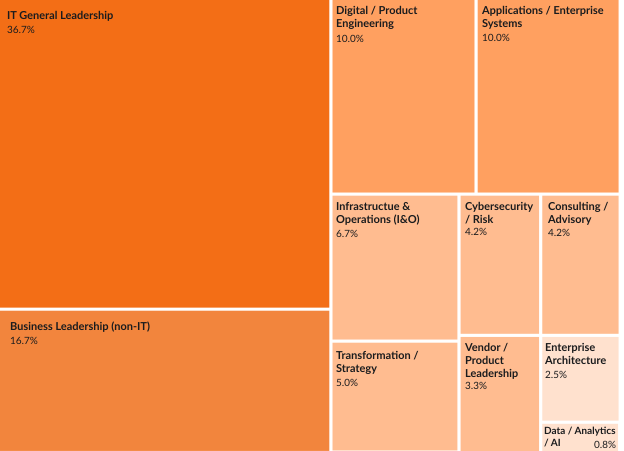
Among first-time CIOs, enterprise-wide scope is the clear default at 78.1%. Divisional/BU experience accounts for 20.2%, and regional roles for just 1.8%. Boards clearly value candidates who have had responsibility across a full company rather than just across a single unit or geography.
Prior role scope, first-time CIOs
Chart would be displayed here
Boards prefer external candidates but split between first-time and repeat CIOs
In the aggregate, boards show a preference for external candidates (59.8%) over internal candidates (40.2%).
Internal vs. external hires
Chart would be displayed here
Industry variation is sharp, however, with Consumer (68.4%) and Financial Services (66.7%) leaning most heavily on outside talent. Industrials (50%) and Agriculture, Energy, and Natural Resources (50%), on the other hand, have the highest internal-hire rates, though both still split evenly between internal and external hires.
Internal vs. external hires, by industry
Agriculture, Energy, and Natural Resources (n=14) and Consumer (n=19) are small subsets and should be interpreted with caution.
Chart would be displayed here
While boards split nearly evenly between selecting first-time or repeat CIOs (48.8% first-time and 51.2% repeat), those numbers vary significantly depending on whether the hire is internal (only 18.2% of internal hires have been a CIO before) or external (73.5% are repeat). These ratios may seem natural. Most internal appointments won’t already be a CIO, after all, but it is noteworthy that such a high percentage of external appointments are repeat appointments. Other C-suite roles don’t always have such high rates of selecting for candidates that already hold the given chair. Externally appointed CHROs, for example, are first-time CHROs 46% of the time. 2
First-time vs. repeat CIOs
Chart would be displayed here
A majority hold master’s degrees, and CS degrees outnumber MBAs
More than half of current CIOs (55.1%) hold a master’s-level credential or higher. CS degrees (any level) outnumber MBAs 49.3% to 33.9%.
Degrees by level and kind
Chart would be displayed here
CS degrees and MBAs both run high among Agriculture, Energy, and Natural Resources CIOs (66.7% and 58.3% respectively), the highest combined credentialing of any sector. The subset is small (n=14), so the magnitudes should be treated with caution, but the pattern is consistent with what one would expect in a technical, regulated industry.
Healthcare and Life Sciences CIOs hold the second highest industry proportion of CS degrees (54.5%). MBAs are the second most common in Consumer (47.4%).
CS and MBA share, by industry
Chart would be displayed here
Agriculture, Energy, and Natural Resources (n=14) and Consumer (n=19) are small subsets and should be interpreted with caution. A CIO holding both a CS degree and an MBA is counted in both.
What’s changed in the CIO profile since 2023?
Digital and product engineering is gaining ground on IT leadership
Among first-time CIOs, IT general leadership remains the top entry point in both cohorts, but its share has dropped roughly 9 points (40.9% before 2023 vs. 31.5% since 2023). Infrastructure & operations dropped over the same period, from 9.1% to 3.7%. Meanwhile, digital and product engineering rose from 6.1% to 14.8%, more than doubling its share and becoming the third-largest pathway among hires since 2023, after non-IT business leadership roles (16.7%). The shifts point in the same direction: boards are drawing first-time CIOs from a less IT-traditional and more product-oriented pool than they did three years ago, even if IT still leads the way.
Prior role family, first-time CIOs, before 2023 and 2023 and after
Chart would be displayed here
MBA share fell from 38.0% among CIOs appointed before 2023 to 29.4% among those appointed since. CS-degree share has remained relatively stable, at 48.2% before 2023 and 50.5% since.
CS and MBA share, before 2023 vs. 2023 and after
Chart would be displayed here
CS share counts any CIO with a CS degree at any level. A CIO holding both a CS degree and an MBA is counted in both.
Boards are appointing older CIOs than they used to
Most CIOs reach the chair in their late 40s or early 50s. The current median age at appointment is 49, with 36.3% of CIOs appointed between 45 and 49. Another 28.2% are appointed between 50-54, meaning the majority of appointments (64.5%) were in the 45-54 range when they were appointed.
Age at appointment, current CIOs
Chart would be displayed here
Since 2023, the median appointment age rose from 48 to 50; the under-40 share fell from 13.3% among hires before 2023 to 3.8% among hires in 2023 and after, while the 50–54 bracket climbed from 23.4% to 34.0%.
Age at appointment, before 2023 vs. 2023 and after
Chart would be displayed here
Female appointments are up, with wide variation by industry
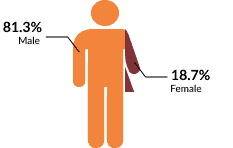
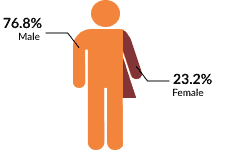
One in five CIOs is female, with the share moving from 18.7% for hires made in 2022 and prior to 23.2% for hires made in 2023 and after.
One in five CIOs is female
Female CIOs hold 20.7% of S&P 500 chairs; male CIOs hold the remaining 79.3%.
Gender, before 2023 vs 2023 and after
Before 2023
2023 and after
Female appointments are concentrated in Industrials (32.1%) and Business and Professional Services (31.8%) and nearly absent in Financial Services (6.7%) and Agriculture, Energy, and Natural Resources (7.1%).
Two patterns are worth flagging. First, the distribution does not track cleanly with the technical-vs-commercial split of the industry. Industrials is technical-heavy and has the highest female share; Agriculture, Energy, and Natural Resources is also technical-heavy and has nearly the lowest. The gender balance across these industries cannot be explained as a story about which sectors hire more technical CIOs. Second, the two sectors with the fewest female CIOs have little else in common. They differ on credential mix, where MBA share runs 58.3% against 29.6%, and on internal hiring, at 50% against 33.3%. No single sector characteristic explains the gap.
Female and male share, by industry
Chart would be displayed here
Agriculture, Energy, and Natural Resources (n=14) and Consumer (n=19) are small subsets and should be interpreted with caution.
What’s next? Action items for boards, sitting CIOs, and aspiring CIOs
For boards
- Reconsider what the CIO role requires in 2026 and beyond. The profile that produced strong CIOs through the cloud and mobile eras may not be the profile that produces strong CIOs through the AI and quantum eras. Separate what the role requires from what the role has historically looked like, and decide what mix you need before writing the next search brief.
- Audit your last CIO search brief against the data. If it hard-codes industry experience or a traditional IT path as a requirement, your spec may be out of step with how the role is being filled. Two-thirds of external hires come from outside the hiring company’s sector, and more than twice as many first-time CIOs come from digital and product engineering backgrounds than they did in 2022 and prior.
- Develop your internal CIO succession candidates by building their technical depth alongside their P&L and enterprise-leadership fluency. Give them opportunities to lead product-building initiatives, not just IT operations. Expose them externally through boards, peer forums, and cross-industry technical communities.
- Treat the CIO seat as one of the highest-leverage selection decisions you will make this decade. The executive most responsible for guiding the enterprise through AI, agentic systems, and quantum risk should be selected with the same rigor, breadth, and forward-looking criteria you bring to CEO succession.
For sitting CIOs
- Treat technical depth as a continuing investment, not a closed chapter. The CIOs who stay relevant through the next wave of change are likely to be the ones who carry the technical weight themselves rather than delegating it. Spend more time with the AI, agentic, and quantum questions than your current role strictly requires.
- Deepen your fluency in finance, business strategy, and the operating realities of the functions you support so you can co-lead AI, digital, and transformation initiatives with your C-suite peers rather than simply enabling them. Technical depth gets you to the table. Business fluency determines what you can do once you’re there.
- Delegate operations, not thinking. Build a high-caliber IT leadership team and an increasingly automated technology operating model so that day-to-day execution runs reliably without your direct attention, freeing you to stay close to the strategic and technical questions that matter most.
- Build relationships outside your company with other CIOs, technology leaders, and the broader vendor and analyst ecosystem. The pace of change makes peer learning more valuable than it used to be, and external perspective is increasingly part of what makes a CIO effective.
For aspiring CIOs
- Build leadership experience across multiple technology functions, not just one. The pipeline data shows boards drawing first-time CIOs from a wider set of pathways than they did three years ago: IT general leadership still leads, but digital and product engineering has more than doubled its share. Leaders who can credibly speak to operations, applications, and product engineering will compete well across more of the openings boards are filling.
- Adjust your timeline. The under-40 share of new CIOs has dropped sharply, and the median appointment age has moved from 48 to 50. If you assumed an appointment in your late 30s, plan for your mid- to late 40s or early 50s, and use the additional time to deepen your enterprise leadership and technical credibility.
- Invest early in fluency on AI, agentic systems, quantum, and the broader technology landscape, so that when you arrive in the CIO seat you can immediately operate as an externally credible advisor to the board and CEO, not just as an internal technology leader.
- Prepare for a role that is changing as you climb toward it. Today’s CIO manages a technology function. Tomorrow’s CIO will likely own enterprise AI strategy and govern how AI agents work alongside human teams. Boards still value technical fluency in the seat, so invest in yours. Aim past today’s CIO and toward the role as it will exist in 2027 and beyond.
Methodology
N2Growth examined over 5,000 individual data points across 21 analytical dimensions, including hiring source, tenure, gender, education, prior experience, and industry background, to analyze and compare the career trajectories and profiles of every CIO in the S&P 500 (N = 246) at the time of the study (March to May 2026). Not every attribute was verifiable for every CIO. Percentages are calculated on the CIOs for whom the attribute is known rather than on the full 246, and records with unknown values are excluded rather than counted as negative. Where applicable, the dataset was split into a pre-2023 cohort (n=134) and a post-2023 cohort (n=112) to identify longitudinal shifts.
1 We define IT-traditional pathways as IT general leadership, applications/enterprise systems, infrastructure & operations, enterprise architecture, data/analytics/AI, and cybersecurity/risk. Digital and product engineering is excluded from this grouping because, although technical, it represents a different kind of leadership track focused on building and shipping software products rather than running IT functions.
2 S&P 500 CHROs. N2Growth analysis.
FAQs
A chief information officer leads a company’s technology strategy, systems, and IT organization. Modern CIOs go further, guiding enterprise decisions on AI adoption, data, cybersecurity risk, and digital transformation, and serving as a strategic advisor to the CEO and board. In most large companies, the CIO holds enterprise-wide responsibility rather than overseeing a single division or region.
Roughly half of S&P 500 companies (49%) have a CIO proper, with 246 CIOs in the chair as of mid-2026. Estimates vary depending on which titles are counted; this study includes only executives holding the CIO title itself, not adjacent roles such as CTO or chief digital officer.
A CIO manages the technology that runs the business, while a CTO typically builds the technology the business sells. The CIO owns internal systems, enterprise infrastructure, data, and IT strategy; the CTO leads product engineering and customer-facing technology. The lines are blurring, however, as boards increasingly draw CIOs from digital and product engineering backgrounds, a pathway that has more than doubled among first-time CIO hires since 2023.
Most first-time CIOs come up through IT leadership roles, but the pathways are widening. IT general leadership remains the most common entry point at 37%, followed by non-IT business leadership at 17% and digital and product engineering at 10%. Enterprise-wide experience matters most: 78% of first-time CIOs held roles with company-wide scope before appointment.
The median age at appointment for S&P 500 CIOs is 49, and most reach the role between 45 and 54. Since 2023, the median appointment age has risen from 48 to 50, while the share of CIOs appointed under 40 has fallen from 13% to 4%.
There is no single required degree, but more than half of S&P 500 CIOs (55%) hold a master’s-level credential or higher. Computer science degrees now outnumber MBAs 49% to 34%, with MBA rates declining among recent hires.
The majority of CIOs are external hires. Among S&P 500 companies, 60% of current CIOs came from outside the organization, with Consumer and Financial Services relying most heavily on external talent. Nearly three-quarters of external hires have held the CIO title before.
The CIO role is shifting from technology management to enterprise leadership. Boards are appointing older, more experienced candidates from a wider range of backgrounds, and increasingly expect CIOs to guide enterprise decisions on AI, agentic systems, and emerging technology risk.
Connect with the authors behind the research

Tony Morales
Chairman
Lead Author
Chicago, IL

Carlos Alfonso Gonzalez
Managing Partner
Lead Author
Mexico City, Mexico
CIO Hiring Trends 2026: Analyzing the S&P 500 CIO
Placing and advising the leaders of tomorrow
As an executive search firm, companies call upon us to find world-class talent and we deliver. But, it’s our fully integrated portfolio of leadership advisory services that sets us apart.
Contact us to learn how we can help you attract, develop, and unleash leaders.
Let's get in touch
Send us a message and a consultant will reach out shortly.
 English (United States)
  English (Canada)
  English (UK)
  Spanish (Spain)
  Spanish (Mexico)
  Spanish (Chile)
  French
  Portuguese (Brazil)
  Portuguese (Portugal)
  Dutch
Dutch